What is SEO and How it Works
(Simple and Easy Explanation)
With trillions of searches conducted every year, search engines are the gateway to the internet. And here's what makes this crucial: 68% of online experiences begin with a search engine. But most websites? They're invisible.
SEO stands for search engine optimization and is how you fix that.
Think of your website like a shop in Singapore:
- Without SEO: It's hidden in some back alley
- With SEO: It's front and center on Orchard Road
Sure, you could dump money into ads (SEM) for instant visibility. Search engine marketing (SEM) is a paid advertising strategies that drive you instant traffic. But that's like renting a spot at MBS - stop paying, and poof - you're gone.
SEO Singapore? It’s like owning that prime location on the search engine results page (SERP). You build it once, and the customers keep coming through search engine results. SEO helps your website appear at the top of search engine results pages, increasing your visibility and credibility.
The best part? Users click on organic search results 94% of the time. It's the difference between being the go-to spot and "that place with all the advertisements." When your site is at the top of search, you drive more traffic and become the trusted choice.
💡 New to SEO terms? Check out our SEO Glossary to quickly learn what key terms like backlinks, meta tags, and more mean.
Listen to the podcast version: What is SEO and How it Works / SEO Explained [Infographics]
What is SEO
SEO (Search Engine Optimization) is the practice of improving a website to increase its visibility so that it shows up when your potential customers search on Google, aligning with the search engine's ranking algorithms.
Think of Google like a helpful librarian. When someone asks "Where can I find books about dinosaurs?", the librarian knows exactly which books to recommend. SEO is like making sure your website is one of those books the librarian suggests when people ask for what you offer. Most people think SEO is complicated and scary. But it's actually just four simple things - we call it our KARA framework. These four things will always help people find your website, no matter how Google changes.
1. Keywords:
Talking Like Your Customers
This is simply the words people type when they're looking for something.
Examples:
- "SEO Services Singapore"
- "Search Engine Optimisation Singapore"
- "SEO Packages Singapore"
They’re all looking for the same thing (SEO services!), but the way they ask reveals their search intent — whether they’re just exploring, comparing options, or ready to hire. Good SEO makes sure your website not only shows up, but also delivers the right type of content for that intent.
2. Accessibility:
Making Your Website Easy to Read
Imagine Google as a reader trying to understand your website. To help Google read and understand your site better, you need:
- Keep things organized (like a tidy room)
- Make it load fast (nobody likes waiting!)
- Make sure it works on phones (most people use their phones to search)
- Fix any broken parts
3. Relevancy:
Being the Perfect Answer
This is like being the kid in class who always has the right answer. When someone searches for something, your website should be exactly what they're looking for.
Key elements include:
- Use clear titles that explain what your page is about
- Write content that actually helps people
- Make your web addresses simple and clear
- Answer the question people are really asking
4. Authority:
Being the Popular Kid
Just like how the cool kids at school get more attention, websites that other good websites talk about get more attention from Google too.
Quality indicators include:
- Get other respected websites to mention you
- Create content so good that people want to share it
- Be consistent and reliable
- Build a good reputation over time
Looking to boost your online presence? Click here to learn how to select the best SEO agency in Singapore that fits your business needs.
How Does Search Engine Work?
Before diving deeper into these principles, it's crucial to understand how search engine work. After all, SEO is all about making your website work well with search engines. The interplay between the web and search engines is crucial, as SEO evolves in response to how users interact with these tools.
As Google is the most dominant search engine in Singapore, most of this guide will focus on the Google search engine.
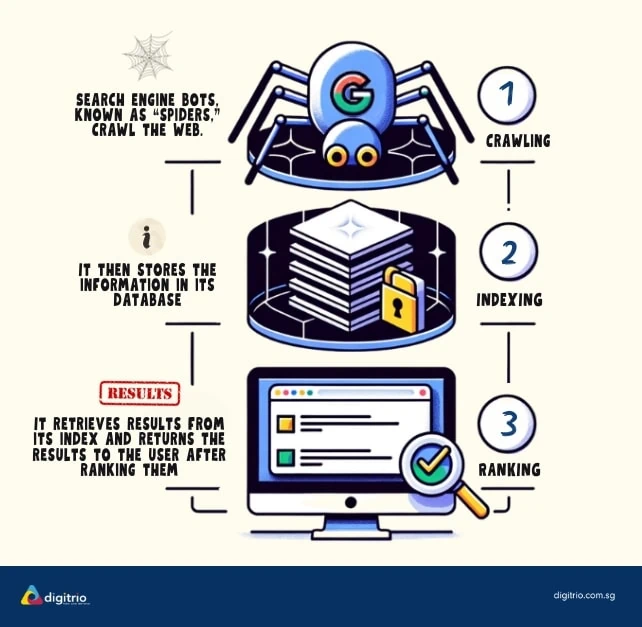
Here are the three functions through which Google search engines primarily work.
Learn more in depth: How Do Search Engine Works
In a nutshell, you are searching through Google’s index of websites and not the entire Internet when you google. Utilizing tools like Google Analytics 4 is crucial for monitoring SEO performance, as it helps track key metrics such as organic traffic and conversions. This is an important concept to understand when it comes to optimizing the accessibility of your website, which will be covered more later on in the article.
Is Your Website SEO Friendly?

How Does SEO Work?
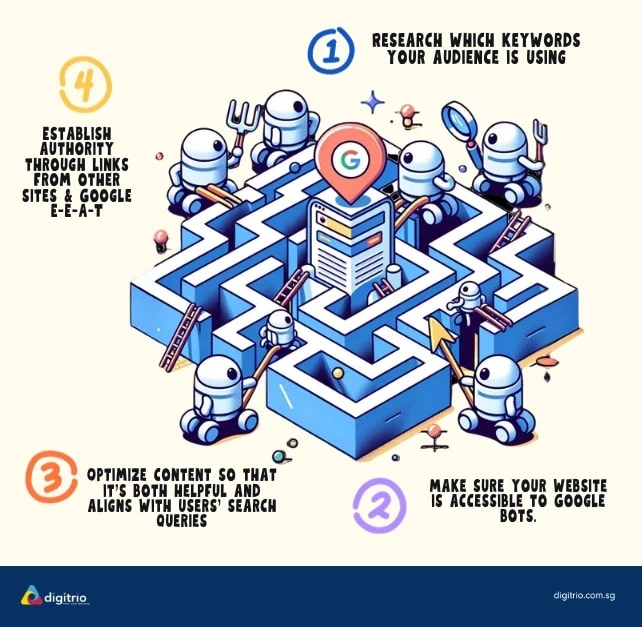
SEO, or Search Engine optimization works by:
- 1Researching and understanding the keywords your target audience uses.
- 2Ensuring your site is easily accessible to Google bots
- 3Optimizing content so that it's both helpful and aligns with users' search queries.
- 4Establishing authority through links from other sites, or more recently, as defined by Google, E-E-A-T (Experience, Expertise, Authoritativeness, Trustworthiness)
What is Google Algorithms

The Google search algorithm is a complex system that allows Google to find, rank, and return the most relevant pages for any given search query. Google employs over 200 SEO ranking factors in its algorithm. Google update their algorithms roughly 500 to 600 times each year to ensure that they are still ahead of other search engines like Bing and others.
One of the most notable algorithms that has solidified Google's position as the largest and most widely used search engine in the world is PageRank.
Google was initially named ``BackRub`` for its analysis of the web “backlinks”
Google PageRank is a link analysis algorithm that assigns a numerical weighting to each element of a hyperlinked set of documents, such as the World Wide Web, with the purpose of "measuring" its relative importance within the set. It is what makes Google become popular due to its accuracy in returning search results when it first came up in 1998.
ONGOING
Core
The Google core update is an ongoing series of significant changes that Google implements in its ranking algorithm. These alterations influence a vast number of indexed web pages. Google has been releasing multiple core updates every year since at least 2018. These core updates can take several weeks to fully roll out and can significantly impact search rankings.

ongoing
Helpful Content Update
Google Helpful Content is an algorithm update introduced by Google in mid of 2022. This update is designed to reward websites that produce high-quality content written for people, rather than for search engines. This update aims to reward websites that provide valuable, user-centric content while demoting those that produce low-quality material primarily for search engine rankings.
ongoing
Spam Update
The Spam Update is a Google algorithm designed to improve the quality of search results by identifying and penalizing websites that violate Google's spam policies. Released periodically, these updates target various forms of spam, including automatically generated content, low-quality or duplicate material, and deceptive practices like hidden redirects

2011
Panda
Google Panda is an algorithm update introduced by Google in 2011. Its aim was to enhance the quality of search results by penalizing websites with low-quality or thin content and rewarding high-quality websites with improved rankings. The update impacted approximately 12% of search results.

2012
Penguin
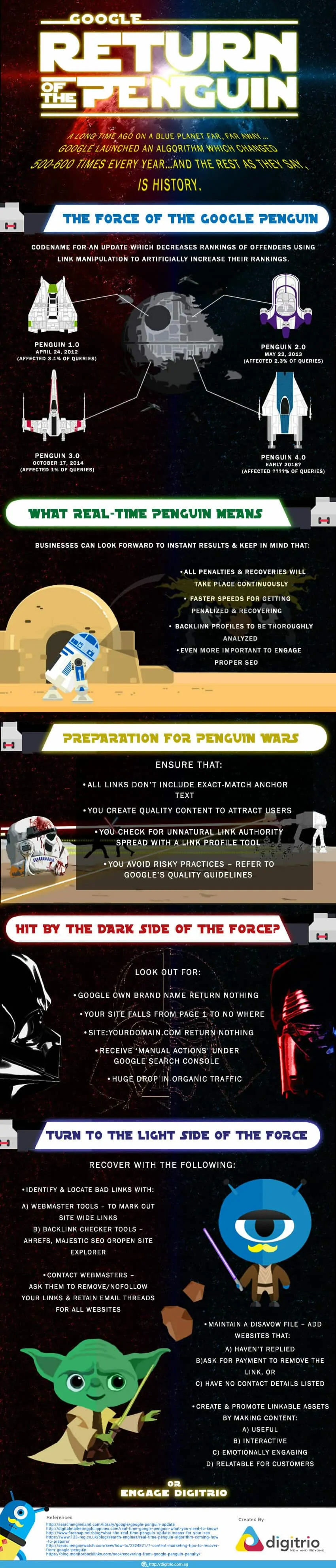
Google Penguin is an algorithm update introduced by Google in 2012. Its purpose was to penalize websites violating Google's Webmaster Guidelines through black hat SEO techniques, such as keyword stuffing, cloaking, and link schemes, which manipulate search engine rankings. The update impacted approximately 3.1% of search queries.

2013
Hummingbird
Google Hummingbird update is an algorithm update that was introduced by Google in 2013. Unlike previous updates, this was a complete overhaul of the search algorithm. It is designed to improve the accuracy and relevance of search results by focusing on the meaning behind the search query rather than just the keywords. The impact of the update was not revealed.
Google algorithm updates can sometimes pose a headache to website owners, but this is something that Google will continue to do as part of its mission to organize the world’s information and make it universally accessible and useful and you can keep up with the major Google algorithms update here.
Google’s Mission is to Organize the World’s Information and make it Universally Accessible and Useful.
SEO Pillars
To truly understand SEO and how it works, we can break it into these 4 main pillars that make up the proven SEO strategy that Digitrio uses.

Keywords are the foundation when it comes to SEO and the type of keyword and the quality of the keywords you target play a big role in the outcome of your SEO efforts.
We want to be targeting keywords that your targeted audiences are most commonly using to search for and below are 4 keys areas we mainly want to look into for quality keywords in SEO:
- Type of Search Intent
- Average Monthly Searches of the Keywords
- Commercial Values of the Keywords
- The difficulty of the keywords relative to your website
You can get the above data using a keyword research tool like Ahrefs or via your own Google search console to identify what keywords you are ranking quite well but not quite there yet.
1. Search Intent
Search intent is about what is the primary goal a user has when searching a query in the search engine, Google. We can classify the search intent into 3 main groups:
- Navigational
- Informational
- Transactional
Understanding this is key as it allows us to make sure we are targeting the right pages to deliver the right search intent, thus able to provide useful information mentioned in the steps to a Google-friendly site from Google.
Navigational
Navigational intent is keywords used when the user already knows the website that they want to go to. For example, when someone types in the name of a particular company or brand along with the specific product or service, they have the intent to access relevant pages about that company or brand.
Eg, Users will type “Digitrio” or “Digitrio SEO services” to visit our homepage or our SEO services page.
(*This type of search query, we often do not target for SEO, as we are most likely already ranking high for our own brand keywords)
Informational
Informational intent is keywords used when users are primarily looking to gain knowledge about a particular topic. These types of keywords have a large volume of traffic, but users aren’t necessarily looking to buy anything. However, ranking for informational keywords can still be valuable as you can direct people to other quality content on your website that may be more transactional in nature.
Eg, Users will type “Benefits of SEO” or “SEO vs SEM” to learn more about these topics.
Transactional
Transactional intent is keywords used when the users show clear intent to buy a product or service in the near term. These types of keywords are the most fierce in competition as most of your competitors will be targeting in their SEO to rank for it.
Eg, Users will type “SEO Singapore” or “SEO services” to find an agency that they can engage for the services.
2. Average Monthly Search Volume
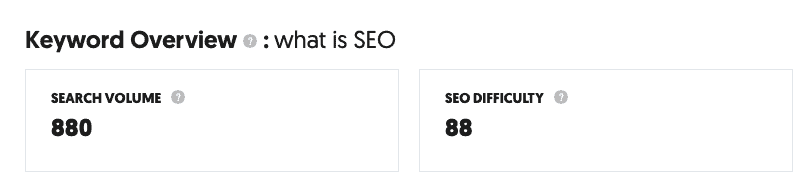
We want to make sure that we are doing SEO on keywords that have a good search volume per month else there is not much point in getting on Page 1 for keywords that your target audience does not use.
Use tools like Google keywords planner or Ubbersuggest to find out if the keywords chosen are being searched by your targeted audience.
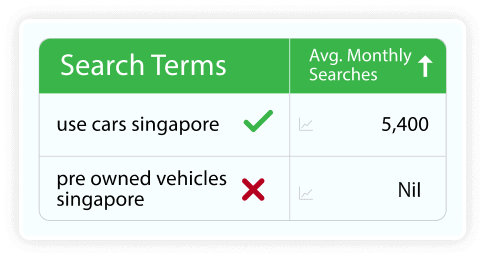
Eg, if you are in the automobile industry, you will want to target “used car Singapore” instead of “pre owned vehicles Singapore” as even though both keywords invoke the same intent as only one has a lot more significant searches volume per month used vs nil.
3. Commercial Values of the Keywords
It is good if the keywords have a lot of search volume per month but does the keywords drive conversion? One of the ways to judge it is via Google keywords planner’s – “Top of Page Bid”. This is Google’s estimate of how much an advertiser generally spends for a single click of that keyword.
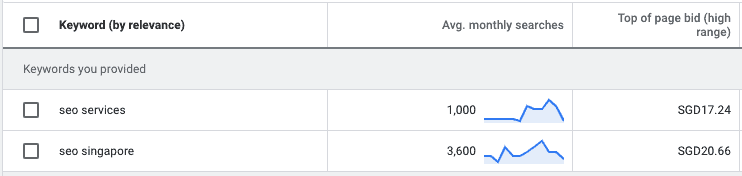
Informational keywords generally have a lower top of the page bid CPC, but they might have significant search volumes.
As such, we define the commercial values of the keywords with a simple formula below:
Commercial Value = Avg Monthly Search Volume * Top of Page Bid CPC
4. Difficulty of the Keywords
The first 3 points are definitely important factors when comes to keywords, but the difficulty of the keywords are crucial among all of them. After all, if we are not able to compete in it and rank in Google’s organic search results – Page 1, we do not get to enjoy the fruit of the labours SEO. (More Traffic & Conversions to your website)
The keyword’s difficulty is based on a number of different factors, including domain authority, page authority, and content quality but that is relative to your website and pages.
Eg, if you are Amazon.com, most keywords are within your range of the target for SEO vs if your website is new whereas not as authoritative as Amazon.com.

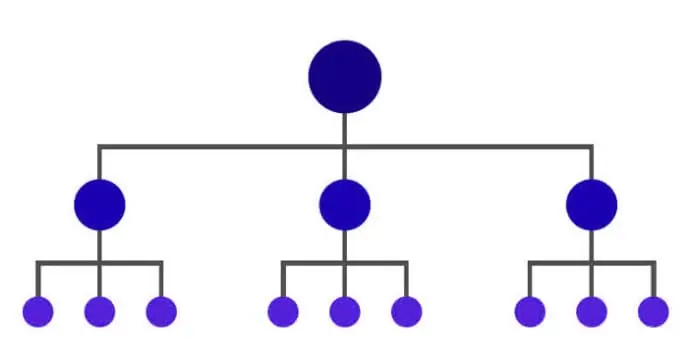
Accessibility is about making sure that your site architecture is in a logical link structure that allows ease of Google to crawl & index it so as to better understand what your site is about.
Below are the 4 main pointers that will allow search engines to better access your website.
- Organized Site Structure
- No Website Errors
- Google Page Experience
- Internal Linking
1. Organized Site Structure
Site structure is how the pages on your website are organized. It is important to be in an organized manner that is flat and well inter-linked.In other words: your site’s pages should all be only a few links away from one another.
This will allow Google to be able to crawl 100% of your site’s ages and able to index them well as that is one of the key parts of the accessibility pillar of SEO.
2. No Major Website Errors
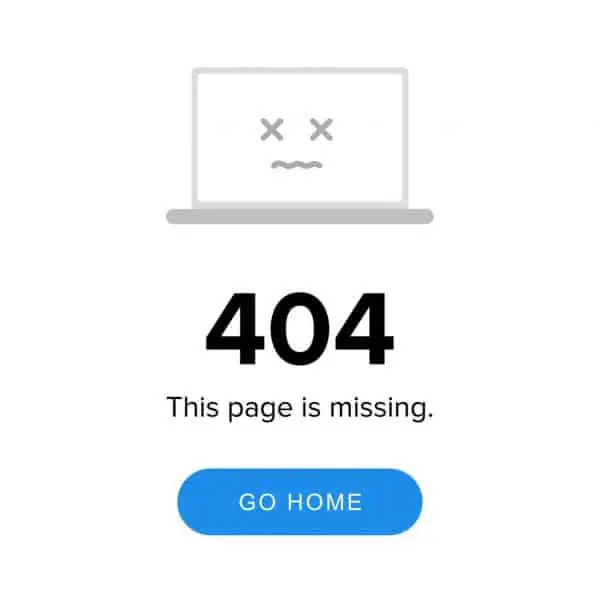
Website errors are pages shown to visitors when something goes wrong when landing on the page. These are bad for SEO purposes because Google can’t crawl or index the page, and also hurts the user experience.
Technical errors like 301, 302, 404, and 500 should be fixed so that Google can crawl the website.
3. Google Page Experience
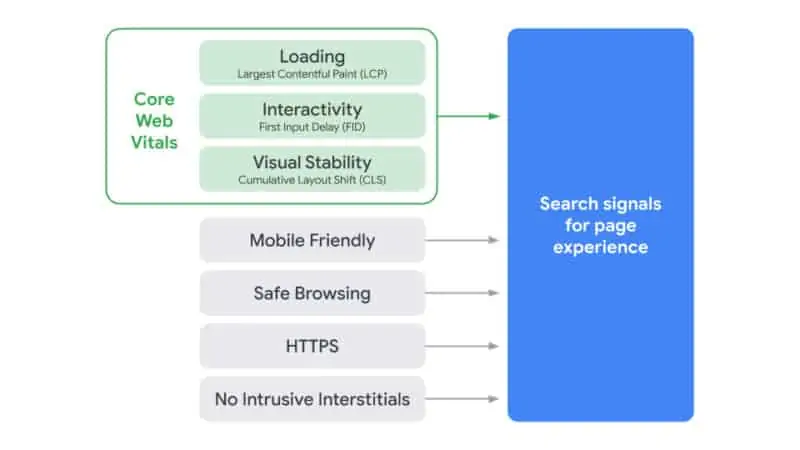
Google Page Experience is a measurement by Google on how well is the user experience when engaging with your website. It looks at the following metrics:
- Core Web Vitals (Loading, Interactivity & Visual Stability)
- Mobile Friendliness of the Website
- Safe Browsing (If there is any malware or unsafe script on the website)
- HTTPS (Secure browsing that contributes to another aspect of safe browsing)
- No Intrusive Interstitials (No Popup Ads that block most or all the pages)
Great user experience is a key factor that Google consider when it comes to search engine optimization (SEO) especially this is one of the rare updates by Google that is transparent and more open about these ranking factors and provides useful tips for improving scores.
4. Internal Linking
Internal linking is the use of links that direct the user from one page on your own site to a different page on the same site. These links stay within your website. For example, there may be an internal link directing traffic from the “Home Page” to the “Contact Us” page.
One key benefit of internal linking is that it helps with the “finding” of this page by Google bots which will further help with the accessibility and it is especially important for pages you are targeting for SEO.
Here are some other ways that your site can benefit from internal linking:
- Establishes an information hierarchy on the site, thus improving your site architecture
- Spreads link equity around the site. Link equity is a Google search engine ranking factor where the links pass authority and value from one page to another. Links that pass equity through link building are used to help determine where you rank on the search results.
- Internal pages on the website can be linked to SEO pages so that Google can easily identify what keywords the SEO page is optimized for.
- Allow visitors to navigate a website and learn more about what you have to offer

Relevancy is about how optimizing your webpage content to make sure it provides useful information based on the keywords entered by the searchers. It is one of the many on-site SEO factors that search engines consider is how relevant the content on the page is to the organic search term or topic.
There are many ways that search engines like Google will evaluate the site content relevance.
- Meta Title & Description
- SEO-Friendly URL
- Header 1, Header 2, and Header 3 & Etc
- Content Matches Search Intent
1. Meta Title and Meta Description
The title tag (meta title) and meta description are foundational pieces to your search engine optimization. They must contain keywords relevant to the content of the page. These meta tags help search engines analyze the page and index them according to relevant keyword phrases. After performing your keyword research, it’s important to incorporate the desired keyword phrase into the meta title and description.
The title also provides visitors with an insight into what the content on that page is about. In addition, the meta description is the words below the title in the search results that inform the reader about the page and get them interested enough to click.
Here are some guidelines to follow:
- The title tag should contain less than 70 characters and should incorporate keywords
- Google and other search engines recommend including your brand in the title, but have them separated from the rest of the title using a colon, pipe, or hyphen.
- Meta descriptions should be between 150 to 160 characters long so that the entire tag fits on the search results page.
- The description should also target a unique keyword but avoid keyword spamming.
- The meta description should engage traffic visitors and entice them to click on the link.
- Consider what the audience from the organic traffic is looking for. Provide words that provide a value proposition such as “Free” or “Voted #1 brand.” In addition, you can include action verbs like “Book Today,” “Shop Now,” or “Read More.”
In addition, you can add structured data so that search engines can better understand what’s on your site. Structured data is a code added to your site’s pages to describe the content contained on the page.
2. SEO-friendly URL
Along with the content, anchor text, title tag, and meta description, search engines will look at your URL to understand what your content is about. An SEO-friendly URL is designed to meet the needs of searchers. Ideally, it should contain the keyword you’re targeting based on your keyword research.
Use hyphens in between words to let the search engine know where each word separates. Also, make the URL short so that Google can easily decipher what the topic of the page is about. In fact, short URLs tend to rank higher on the search results page than long URLs.
3. Header 1, Header 2, and Header 3 & Etc
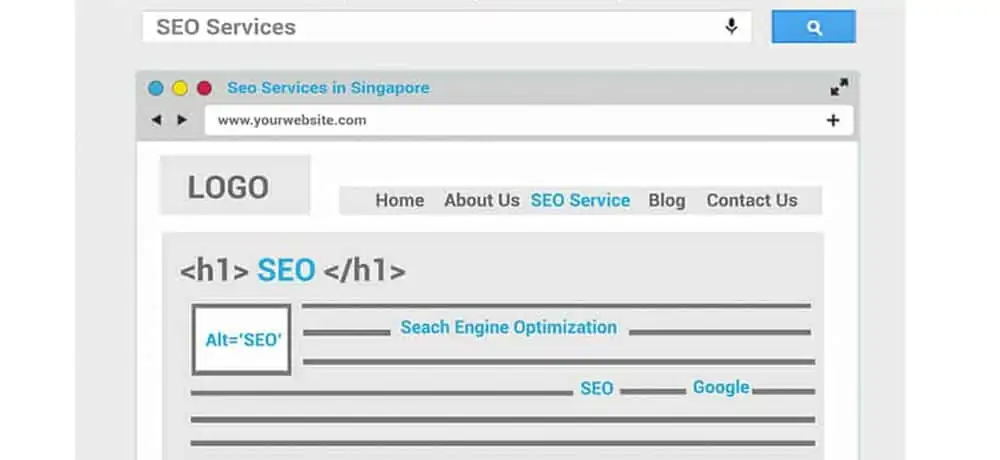
Search engines work to understand your content so that they can provide the most relevant pages to users. Heading tags are elements from an HTML code allowing you to structure your content on web pages. There are 6 HTML tags: H1, H2, H3, H4, H5, and H6. Each tag corresponds to a ranking level where H1 is the most important and H6 is the least important. Just like the other title tag and meta description, make sure to include your target keyword phrase from your keyword research in some of your headers.
Heading tags have a few benefits:
- They allow traffic visitors to glance at the content map and directly read the section that interests them.
- Headings allow the writer to structure their ideas.
- Search engines can easily identify the difference between headings and content text blocks, enabling them to comprehend your page better.
4. Content Matches Intent
Search intent is the goal that a user has when they’re typing their query. Search engines will rank pages higher if their content matches the user’s search intent. For example, a user looking for a pizza recipe has a different search intent than someone looking for takeaway pizza.
If users find what they’re looking for on the site, they’re less likely to bounce and return to Google within seconds. Thus, if your content matches the search intent, you’ll see low bounce rates.
One way to see the best type of content that matches the search intent is to do a Google search of the keyword and read the content of the top websites on page 1 to get a sense of the intent and from there optimize your content on the page to make sure it provides the answer that the searchers are looking for.
Learn more: SEO Copywriting services in Singapore

Authority is about optimizing your website to be more trustworthy to Google through acquiring links.
Link building is the process of getting other high-quality websites to link to your website. Search engines want to provide users with reliable and credible information and one of the ways they use to identify it is if other websites link to you. Google interprets a link from site A to page B as a vote by page A for page B. Votes cast by pages that are themselves 'important' weigh more heavily and help to make other pages 'important.
Below are 3 factors search engines like Google consider:
- Quantity of Links
- Quality of Links
- Anchor Text
You can know what page on your site has links by viewing that information in the Google search console or using a 3rd party tools like Ahrefs.
1. Quantity of Links
As mentioned above, search engines like Google view links as “votes” as such one of the important factors in authority is the number of links.
Eg. If site A has 1000 links and site B has 100 links, site A is more authoritative in the eye of search engine optimization. (If we just compare on the number of links only)
But another key factor is the quality of links, thus it is important to have a high quantity of quality links vs just going after pure quantity.
2. Quality of Links
Quality of links is how search engines measure if the links are relevant and from a trusted website.
Eg, A link from Amazon.com definitely carries more weight than 1 from an unknown website.
Search engines are able to recognize relevance, intent, and linking patterns. Instead of focusing on acquiring links from every source possible, we should acquire links from trusted sources that are of the following:
- Same Niche as your website (The same category of the website, Eg If you are in the dentist industry, it is best to acquire a link from a health-related website)
- High Domain Rating (SEO tools from Ahrefs that measure the authority of the website)
- Great Organic Traffic from the site (If the link from the site, have great organic traffic – not only do we get referral traffic from it but it is also a good sign that the site is trusted since they are able to have traffic from Google itself and is ranking on Page 1.
3. Anchor Text
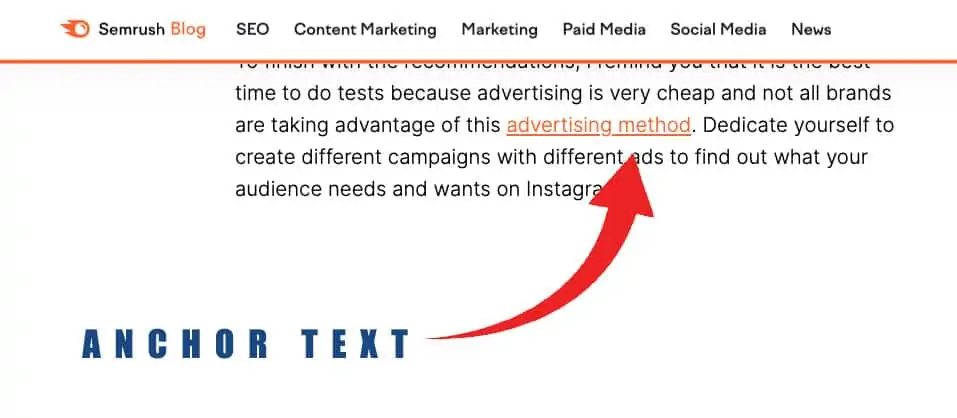
Anchor text is the visible, clickable text in a link. As covered above, the quantity and quality of links are keys but what is the text used to link in a.ka anchor text are equally important.
Search engines use anchor text as a reflection of how other people view your page — and by extension, what your pages might be about. It is important in search engine optimization that the anchor text ratio is natural.
Eg, if your website suddenly acquires 100 links of “SEO services” anchor text – that is a sign that you are engaging in spammy activities which then will affect badly your ranking and SEO.
Anchor text can be categorized into the following:
- Exact Match (Contain what your SEO keywords are about)
- Partial Match (Partial match what your SEO keywords are about)
- Brand (Company name or variation of Company)
- Natural (“click here” or “learn more” are an example of it.)
At its core, Search Engine Optimization (SEO) revolves around four fundamental pillars: Keywords, Accessibility, Relevancy, and Authority. These essential elements form the foundation of effective SEO and have remained consistent principles throughout the years.
While these foundational concepts remain stable, the way search engines - particularly Google - evaluate and measure them continues to evolve. A prime example is Google's recent implementation of Core Web Vitals within their Page Experience metrics, which has introduced new dimensions to how they assess website accessibility. These ongoing refinements demonstrate the dynamic nature of SEO implementation.
For comprehensive performance tracking, tools like Google Analytics and Google Search Console provide invaluable insights into your website's metrics - and best of all, they're completely free to use.
Ready to understand your website's SEO performance? Take advantage of our free SEO audit tooltoday. If you're looking to improve your search rankings and drive more targeted traffic to your site, our expert team is here to help - just reach out to learn more about our professional SEO services.
Different Types of SEO Methodologies
Search Engine Optimization (SEO) comes in various forms, methodologies, and approaches, each playing a crucial role in enhancing your website's visibility in search results. However, it's important to be cautious about which approach you choose, as some methods can have negative consequences if not implemented correctly.
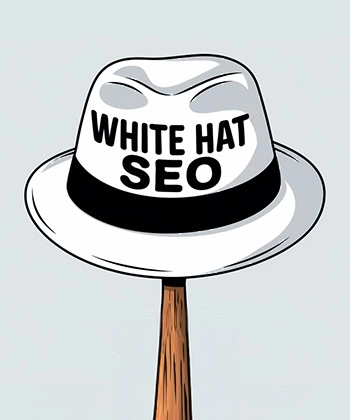
✅ The recommended approach that follows search engine guidelines:
- Creating high-quality, original content
- Natural link building
- User-focused optimization
- Proper technical implementation
- Sustainable, long-term results

❌ Strictly forbidden practices that violate search engine guidelines:
- Keyword stuffing
- Hidden text or links
- Cloaking
- Doorway pages
- Link schemes
- Content automation
- Can result in permanent site penalties
⚠️ Practices that fall in a questionable area between white and black hat:
- Creating high-quality, original content
- Natural link building
- User-focused optimization
- Proper technical implementation
- Sustainable, long-term results

🚫 Unethical practices aimed at harming competitors:
- Toxic backlink attacks
- Content scraping
- Fake negative reviews
- False copyright claims
- Should always be avoided
Core Types of SEO Strategies
SEO encompasses four essential strategies to improve your website's search visibility. On-Page SEO deals with optimizing individual page content and elements to improve rankings. Technical SEO ensures your website's infrastructure is search-engine friendly. Off-Page SEO builds your site's authority through external factors. Local SEO helps businesses connect with customers in their geographic area.

On-page SEO (also known as “on-site SEO”) is the practice of optimizing web page content for search engines and users. On-page optimization is a key component of SEO that involves enhancing website content to ensure it is both user-friendly and search engine-friendly, thereby improving search rankings and user engagement. Common on-page SEO practices include optimizing title tags, content, internal links and URLs.
This is different from off-page SEO, which is optimizing for signals that happen off of your website (for example, backlinks).
Why is On-Page SEO Important?
The majority of today’s search engine optimization work focuses on on-page SEO. The reason for this is that Google and other search engines like to focus primarily on content and meaning.
SEO is not just about keywords and link building anymore. It’s all about providing a great user experience, which leads to higher rankings in the SERPs (Search Engine Result Pages) and content play an important part of it.
It’s important to optimize your website not only for users but also for Google, as it is one of the most used search engines nowadays – over 90% of its users use Google as their primary search engine.
What On-Page SEO Ranking factors Should You Take Note of?
Critical considerations for On-Page SEO include:
- URL
- Title tag
- Meta description
- Heading tags
- Alt tags
- Keywords
- Content
- Internal linking
- Images

Technical SEO mainly focuses on the way Google crawls pages. It does so behind the scenes, with important elements such as meta descriptions and keywords. This makes your site very fast and relevant for search engines that can easily crawl it.
Why Is Technical SEO Important?
Why do you want to prioritize technical SEO? Well, technical SEO is what allows search engines like Google to know that you have a website of high value. You should engage in Technical SEO because it allows you to be found easily and increases your chances of higher rankings. For example, it could provide information about your company and its respective products.
If Google prioritized webpages that was slow, non-responsive or confusing to navigate, Google users would be more likely to take their search queries somewhere else. So if your website loads quickly, has no dead links and is secure, Google’s crawlers will give it an extra boost in search rankings.
The reasons for this are evident. Creating a strong technical foundation for your website will go a long way in satisfying and delighting your users. Search engine crawlers take notice and prioritize your website over others who offer slower and buggier experiences.
What Technical SEO Ranking factors Should You Take Note of?
Critical considerations for technical SEO for ranking factors include:
- Domain age
- Domain strength
- No plagiarized content
- URL structure
- No dash domains
- 301 redirects
- Canonicalization
- Website Page speed
- Mobile optimization - essential for modern technical SEO
- Site navigation

“Off-page SEO” (also called “off-site SEO”) is when you do things outside your website to impact your rankings in SERPs, like with on-page SEO.
Optimizing for off-site ranking factors involves improving search engine and user perception of a site’s popularity, relevance, trustworthiness, and authority. This is done in a number of different ways. For example, by other reputable websites/blogs/individuals linking to your website and giving it good reviews, “vouching” for the quality of your content.
Why is Off-Page SEO Important?
Off-page SEO is important because it can increase organic search rankings and traffic to a website. By implementing off-page SEO efforts, website owners can build links and social media mentions that point to their site. These links and mentions help to indicate that the site has credibility and authority, which improve the site’s rankings on organic search results pages.
There are many search algorithms and ranking factors, but SEO experts argue that the relevance, trustworthiness, and authority of sites affect their rank and off-page SEO play an important in achieving that.
What Off-Page SEO Ranking factors Should You Take Note of?
Building backlinks is critical for off-page SEO to rank well in search engines. This means that a site with many high value backlinks should rank higher than an otherwise similar one without as many.
Critical considerations for Off-Page SEO include:
- How related the linking site’s topic is to the site being linked to
- The anchor text used on the linking site
- The trustworthiness of the linking site
- The number of other links on the linking page
- Authority of the linking domain and page
- The “freshness” of the link

Local SEO is the practice of optimizing your online presence to attract more customers from relevant local searches. These searches take place on Google and other search engines, specifically targeting businesses, products, or services in a particular location.
Why is Local SEO Important?
Local SEO is crucial for businesses that operate in specific geographic areas. As more consumers turn to search engines to find nearby products and services, local SEO has become essential for business survival and growth. With the majority of local searches leading to store visits or calls within 24 hours, having a strong local online presence can directly impact a business's foot traffic and revenue.
The rise of "near me" searches and mobile-first indexing has made local SEO more important than ever. Google prioritizes showing local results to users searching for businesses, products, or services in their vicinity, making it crucial for local businesses to optimize their online presence.
What Local SEO Ranking Factors Should You Take Note of?
Critical considerations for Local SEO include:
- Google Business Profile (formerly Google My Business)
- NAP Consistency (Name, Address, Phone Number)
- Local keywords
- Local backlinks
- Online reviews and ratings
- Local citations
- Location-specific web pages
- Schema markup
- Mobile optimization
- Local content creation
Why Is SEO Important For Your Business?
If you're running a business in Singapore, here's the deal - SEO is way cheaper than burning cash on paid ads. Think about it: with paid ads (like Google Ads), you're constantly paying for every click. Stop paying, and poof - your traffic disappears.
But with SEO? You put in the work once, and the benefits keep growing. It's like planting a tree - it grows bigger and stronger over time, bringing more visitors to your website month after month.
Here are the key benefits of investing in SEO:
1. Increased Visibility and Organic Traffic
The numbers tell a compelling story about SEO's impact on business visibility:
- Organic search drives an overwhelming 53% of all website traffic, making it the single most powerful channel for reaching customers. The importance of organic search traffic cannot be overstated, as it is free and can significantly contribute to a website's overall traffic share.
- SEO generates over 1,000% more traffic than organic social media efforts
- 95% of search traffic goes to first-page results, highlighting the critical importance of strong SEO
Real Business Impact: When you achieve first-page rankings, you're not just getting more visibility – you're getting quality visibility. With the first five organic results receiving over 65% of all clicks, securing these positions can transform your business's online presence.
2. Enhanced Trust and Credibility
Trust metrics demonstrate SEO's power in building credibility:
- SEO leads have a remarkable 14.6% close rate – 8.5 times higher than outbound leads
- 75% of users never scroll past the first page, viewing top-ranking sites as more trustworthy
- URLs containing relevant keywords achieve 40% higher click-through rates, signaling enhanced user trust
Building Long-term Authority: When your website consistently appears in top search results, it creates a powerful psychological effect. Users naturally associate high search rankings with expertise and reliability. This organic authority building is far more valuable than paid advertising, as it represents earned rather than bought trust.
Improved User Experience
User experience metrics reveal SEO's crucial role in satisfaction:
- 53% of mobile users abandon sites that take over 3 seconds to load
- Over 60% of mobile searchers prefer contacting businesses with mobile-friendly websites
- Good SEO practices directly contribute to better user metrics, with optimized sites showing lower bounce rates and higher engagement
The SEO-UX Connection: Modern SEO is intrinsically linked to user experience. When you optimize for search engines, you're simultaneously improving site speed, mobile responsiveness, and content quality – all factors that directly enhance user satisfaction and engagement.
Cost-Effective vs Paid Ads
The financial advantages of SEO are clear:
- 49% of marketers identify organic search as their top ROI channel
- 59% of SEO campaigns show positive ROI within just 12 months.
- 88% of marketers currently investing in SEO plan to maintain or increase their investment
Long-term Value Creation: Unlike paid advertising, where benefits cease immediately when spending stops, SEO creates lasting value:
- Content continues working for you 24/7
- Rankings can persist for months or years
- Compound effect as authority builds over time
- Over 60% of B2B marketers rate SEO as their most successful lead generation strategy
The Importance of Search Intent in SEO
One of the most critical elements of modern SEO is understanding search intent — the reason behind a user’s query. Google’s algorithms are increasingly designed to match search results with the intent of the searcher, whether they are looking for information (informational intent), comparing options (commercial intent), or ready to make a purchase (transactional intent).
This is also why SEO today is not just about a fixed number of keywords. Many agencies still charge based on “X keywords per month,” but that model ignores intent and how people actually search. The same service can be searched in dozens of ways — what matters is that your site shows up with the right content for the right intent, not whether it’s tied to an arbitrary keyword count.
For example:
Informational queries: Provide comprehensive, educational content that answers questions in detail.
Commercial intent: Create comparison pages, case studies, or product/service explanations.
Transactional intent: Focus on clear CTAs, landing pages, and persuasive copy that drives conversions.
At Digitrio, our SEO services are designed around this approach — building strategies that adapt to search intent and cover the full spectrum of ways people look for your business, instead of limiting results to a handful of “package keywords.”
By aligning content with intent, you improve not only rankings but also engagement metrics like click-through rate (CTR), time on page, and conversions.
Emerging Trends in SEO (2025 and Beyond)
The search landscape is undergoing its most significant transformation since the mobile revolution. Google's search market share has dropped below 90% for the first time since 2015, hovering in the high 89% range for most of 2025, while Google's global traffic decreased 7.91% from 2023 to 2024. This shift signals that users are diversifying where they search for information. As we move into 2025 and beyond, two major trends are reshaping how businesses approach search optimization:
With ChatGPT, Google AI Overviews, and Google AI Mode (now rolled out in the US and India) becoming mainstream, artificial intelligence has fundamentally changed how users search for information. Rather than typing keywords, people are having conversations with AI systems that provide direct, synthesized answers. AI Overviews take up 42% of the screen on desktop and 48% on mobile, pushing organic results way down the page. To remain visible in this new environment, businesses must embrace Generative Engine Optimization (GEO) by structuring content so AI systems can easily understand, extract, and cite your expertise in their responses.
Search behavior has fragmented across multiple platforms. Users now turn to Reddit for authentic reviews, YouTube for tutorials, TikTok for product discoveries, and AI tools for quick answers. This shift demands Search Everywhere Optimization to ensure your content appears wherever people search, not just on Google. Success requires creating platform-specific content while maintaining consistent authority signals across the entire search ecosystem.
The future belongs to brands that optimize for both AI consumption and multi-platform visibility. By implementing GEO practices and expanding beyond traditional SEO to embrace search everywhere optimization, businesses can future-proof their digital presence and remain competitive as search continues to evolve.
Understanding SEO Through Infographics
SEO infographics are powerful tools that visually simplify and enhance the understanding of key concepts in search engine optimization. Below are 3 infographics on SEO that you can learn from. Visit our blog to keep up with the latest articles, tips, and analysis on SEO.
What is SEO & How it Works Infographic
This infographic breaks down the concept of SEO, simplifying it into key components: Keywords, Accessibility, Relevancy, and Authority.

Website Redesign SEO Checklist Infographic
This infographic is a checklist of the different stages of a website redesign and what to take note of to not only maintain but also boost your SEO.

Google Penguin 4.0 Update Infographic
This infographic details the Google Penguin 4.0 update, introducing real-time penalties and rewards for link quality on specific pages.